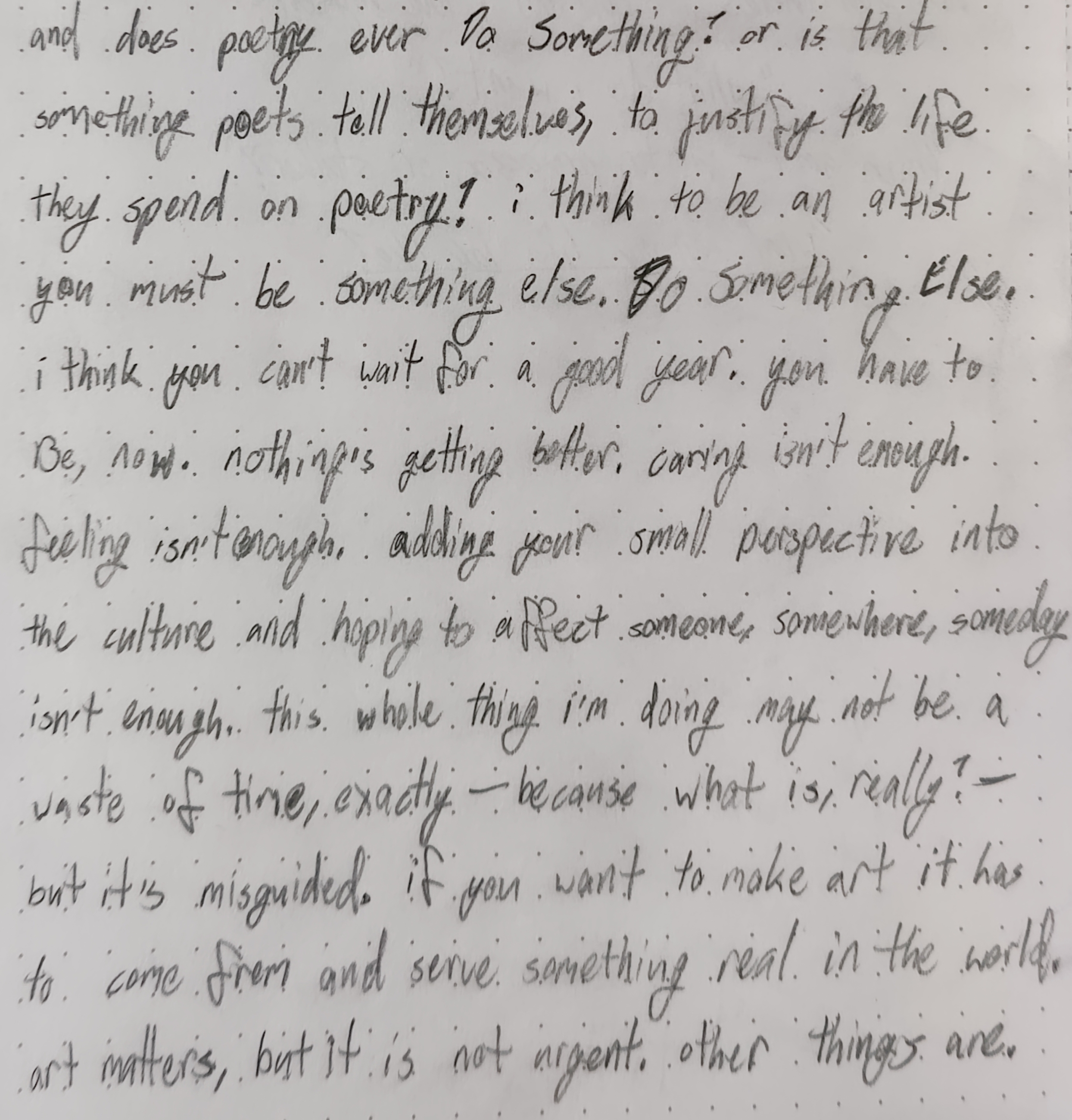
be here, now. it's already too late and there is always still time. nothing's going anywhere without you.
this will all look better on an actual computer--firefox in particular makes some lil details work. but do what u want, i'm not your dad. and your dad shouldn't tell u what to do either.
stay a while,
~m
      it lives as lavishly in my lungs and letters
      as it festers in you:
      entangled as we are where you spin
      i tumble too
      when the sinking Something seeps
      to fill the cracks in you
      my love it sinks me too

      it's not the scars that i resent
      along your tangled arms
      tucked behind your mother's eyes

      not the anguish i lament
      loss held
      and dealt in turn

                but the lack of tears strewn
                across your own abundant body

                and the love you spill so recklessly
                into any heart but yours
still
        this cool August still flowers
          crisp without falling
        mist without rain
          sleeping you hear waves
        crash in place

        for once or again you are changing
          haze clearing cataracts
        and nothing
          ends
        everything
          happens
        without warning
same time tomorrow?
          the turbulence is built in and you,
                  my love are taking shelter
                                    in a sea
                      of new life city blocks
              streets awash and eyes clouded
                        with a good too much

          you fear you can’t control anything
                          and i reassure you
                     it’s true: not even you.

                    you thank me in big words
                              and soft hands
                                  and a push
                                out the door
Hypocrite Seeks a Way Out
        You want to write but you don’t
	             read.

        You want to listen but you don’t
	             speak.

        You want to be loved but you don’t
	             like it.

        You want to be everything but you won’t
	             just be.

        You want to be good but you can’t
		                    You are.
premonition on campus
        in Princeton today I am dying.
        trees totter in cool suits
        waiting for the fall

        in Princeton today more are hungry
        than you’re willing to know
        living in lobbies, dying
        more than the rest

        in Princeton today light is gray
        deer know something’s different
        and don’t say a word

        in Princeton today I am not really dying
        but the plants and the streets and the people
        who make them will be
        soon.
      today I am weak.
      as cold tea, as an excuse,
      poised to spill.
      I fail to force smiles,
      admit a migraine
      before noon. I am
      a poor host but I beg
      it remove its shoes.

      today I am pale.
      as a waning bruise, as a cracking
      egg. new fall's
      hands are full of wind,
      knowing, maybe, I
      can take no more.
      a kind sun warms,
      weakens me into sleep.
    It is work to stay warm. I want to be
    in my hands in a mouth that laughs
    as gently as I feel. I want to tell
    you in every cell and sound
    I know. I see.
    I always will be.
    I will crack
    and joke, I will sing and swear
    You are safe.
all the answers
are small:
plucked strings,
old sun in open doors.
a cat’s slow curled breath.
desperation and a willingness
to sleep. a few tears,
a good show.
If I had it right now I would change everything I could think to change pierce ears and nostrils create a thick armor of symbols I could never take off dye my hair or cut it off I don’t care I’ve been me for centuries and I can’t change that but I can change everything else I’d paint my nails black and shallow learn to really play piano start talking louder like I don’t give a fuck who hears love more softly and truly there’s always been something dishonest about passion like who are you really trying to convince?
But I don’t have money so I won’t do any of that even the parts that are free instead I’ll kiss a boy with a sharp jawline drink rum and cokes that just taste like rum ruin my white shoes smoking with girls I don’t know by a lake I’ve never seen even though I live here run and run and run til I’m running down my own face unable to keep those smiles and eyes in my head they’ll slide and tumble into the road and I’ll be faceless but at least I’ll exist and at least I won’t love anyone as much as I love everyone I don’t make eye contact with on the bus.
      He glows awkwardly in
      Pajamas in my doorway;
      My love ruffles her wings.

      A gift to her is a long con,
      A promise held hard
      That another shoe will drop.

      To be given two soft
      Socks with no warning
      Attached is unbearable.

      She cries into my shoulder
      When Dad leaves. He bustles,
      Humming through my childhood

      Home.
      A sock to him is a sock,
      And nothing less.
the earth what swallows you shall in turn spit you out greenand unafraid.
      i get why all those great writers were drunks
      and depressed i never wrote more truth and light
      than when i wanted to die.
      only a year ago feels solar systems away
      the distance between my center and someone else’s
      now i’m ‘healthy’ in this fog of inexpressibility
      even this feels false i hope that’s self-imposed.
      feelings are thinner now i think i could blow
      them away like tragic cobwebs
      i miss the spiders i wish they’d come home.
      as often as light let yourself:
      think of words how you eat
      and are eaten by
      how all you touch is
      & becomes you

      breathe hard to trees
      friends in this world
      drink deep of all loves
      and savor your grief
      as it goes down.
a fragment, in progress
You told me to get home safe and unfortunately I did. You said it like a secret, your breath hot in my ear, your hand on your new man’s lower back. I couldn’t stand the pity, the sigh in your voice—I wanted to vomit or hit you and maybe I should have. And I know, I know I’m too much of myself, I’m a fucking downpour, I know and I don’t blame you but it hurt. I don’t want to be like this either. I’m tired too.
But you aren’t here. This is stupid.
With some effort I yank my attention out of the whirlpool of my insecurity to find the living room dark and achingly quiet. Time isn’t on my side right now but I spend a long twisting moment in the black and feel it begin to thicken before me into a kind of fabric. Not an absence, not a lack, but something. Velvety, disorienting and too deep. I’ve known that I’m drowning here in my dad’s house but in this moment I can actually feel it happening. Either I or the room start to spin, and it’s just as well. You wouldn’t let me keep dancing. I hear a laugh rasping from my chest and I wonder whose it is.
But my gaze, drifting across shadowy masses in the room around me, finds Pants perched like a tiny gargoyle on the kitchen counter. Her voice is high and clear, an inquisitive rrraah. The dark seems to thin and I remember how small I am.
“Hi, baby.”
She stretches her head upward to meet my hand, closing her eyes as she makes contact.
“I know, Pants, I know,” I murmur as she gorges herself on my affection, digging her cheeks against the two acrylic nails that haven’t yet fallen off my left hand.
I break away for a moment to check her food bowl. She follows me, chirping anxiously. I drop her a neat scoop of wet food and listen to her smacking sounds as I stand in the kitchen illuminated only by tiny blue lights on the outside of the fridge.
If there’s an opposite of misophonia I have it. I expect most people would claw their ears off to the sound of a cat messily chomping at salmon paté, but it’s satisfying to me. Squelching, scraping, metal on metal, teeth on bone, styrofoam shrieking, glass against stone, all of it soothes me in a way that no one I’ve ever met can even fathom. It’s like itching a scab, or your ears suddenly popping hours after a long flight. It makes my inside feel contiguous with my outside. You don’t get it, but I don’t think you’ve ever tried to.
Maybe you weren’t, tonight, as cold as I remember. I was drunk—am—and you don’t exactly make things easier for me, but I can accept that the bitterness and old anger I was drowning in all night were probably more from me than you. That’s my material, as you used to say when you still talked to me.
Sorry, I know you still talk to me, but I’m talking about talking. I don’t have to explain myself, fuck you. Sorry. I can’t keep thinking about this.
I sigh so loudly that it’s almost a word, and Pants looks at me.
“He brought his new boy tonight,” I tell her. “Yes, he’s cute. Kind of annoying though, like he won’t stop laughing a little too hard at everything, you know? Like, he’s trying to make everyone comfortable and ‘active-listen’ to everything which—yeah, it’s nice, good trait, whatever. But he’s clumsy. He’s just the tiniest bit too obvious about what he’s doing and instead of being sweet it’s fucking infuriating. Ugh.”
Gossipping with my cat is getting my blood flowing and I realize I’ve stayed awake so long that I’m starting to feel my hangover while I’m still drunk. I start to fill a glass with water from the painfully slow fridge dispenser.
“You don’t care,” I sigh, “Good for fuckin’ you.”
Her eyes, wide and pale green, are entirely uncynical. None of the haughtiness and apathy of Marley’s forest green gaze or Charlotte’s shameless, imperious blue, just sincere interest, underlaid at most times with a wariness she makes no effort to hide. She looks at you, cocks her head—slightly too small for her round, blue-gray body—and speaks.
I wonder again what it was like for her to be a stray in D.C. before my sister found her. For a house cat she’s had a hard life, and if you know her you can tell. It’s not just that she’s skittish, never sleeps soundly and runs if you hold anything above her head—you can see that she’s grateful, in a way the other cats aren’t, for her home. For us. I can understand that.
Still, sometimes—when I let her in after a night spent in the cold on the porch, when Charlotte’s taken swipes at her, when she spontaneously determines that she will die imminently without affection—her voice raises to this panicked pitch and becomes a drawn-out undulating wail and she gets underfoot and needs too much, and I have to confess in those moments, part of me hates her. I know that’s unfair, but there it is.
I sometimes imagine that’s how you feel about me. Maybe that’s unfair too, but I don’t think it’s a stretch. I see your eyes when I’m being a little too much, a little too direct, too vulnerable—I can even feel your tone shift over text if that’s where we’re talking. When I get sick of speaking obliquely and ask you what I mean to you. When I admit, again, my inability to move on. When I call attention to our little cyclical game. I know you don’t like that. It makes for an ugly character.
Upstairs I remove my makeup in the mirror while making as little eye contact with myself as possible. I know what I am. I ritually swish around stringent mouthwash, change into a pajama shirt, and open Instagram while I pee.
Somehow I find myself on your profile, and my thumb overrides my defenses to open your story. There’s a contextless one-second video of a hazy blue drink, followed by an out-of-focus picture of the party, with your small reflection crystal clear in a distant mirror. Your expression is somehow self-aware without being embarrassing. There’s an implicit joke in your raised peace sign, in your having found the one tiny mirror in the room and yourself within it, but your smile is placid and just earnest enough that even I can’t view you as anything other than endearing.
I resist the urge to flush my phone down the toilet, and go to bed.
By three o’clock the next day I’m dressed in my work clothes and convinced that I’ll be hungover for the rest of my life. Saturdays are good money, but even on the best of days it barely feels worth it. I fill up a water bottle, start chewing some Tums and almost walk out the door before I remember the dog.
“Em!” I shout up the stairs. “Take Trix out I’m running late!”
A vague affirmative drifts through her closed bedroom door.
I thank her in a nasal voice and close the front door behind me.
I can’t tell if the mistake I made was falling in love with a close friend or becoming friends with someone I was in love with. Maybe you have an argument for one or the other. Maybe you’d tell me if I could get you to talk for real with me again, ever. Regardless, I’m reminded of my mistake every time I go to work. Asher knows you, Melissa B knows you, Melissa H used to fuck you, Lauren practically worships you and won’t let anyone forget it, even Simón knew you before he knew me. And every single fucking one of them knows we were at the same party last night.
“What’s the deal with his new boyfriend?” Melissa B whispers as I’m putting a twelve-top’s order into the computer. “Is he that cute in real life?”
I don’t remember you using the word boyfriend, but I can’t exactly point that out without looking like a fucking psycho, so I just roll my eyes. Sensing an opportunity, Simón looks up from the bread he’s cutting to join in.
“You had a threesome, yeah?” He mimes something unclear but certainly vulgar with his fist.
I take it like the joke it is, returning his gesture even more aggressively.
He and the other cooks just laugh, and Simón keeps slicing sourdough.
I’d love to blame you for my reputation as the unstable scorned lover, the girl who never got over the star head server who moved on to greener pastures and left me in the dust. I’ve tried—I really have—to make it your fault, plenty of times over the years since we graduated and you disappeared from my world. But I’ve never been able to convince myself, much less anybody else.
Why couldn’t you have done more wrong? Why were you so impossible to cram into the role of the villain? It would have been so much easier. All of this would have been easier. I wish you hadn’t been up front with me about your ambivalence. I wish the cracks in us hadn’t always been so obvious. I wish you’d written me a letter telling me everything you hated about me, and left me with nothing but the worst of both of us. I could have hated you forever. I could have seen you as beneath my hate. I could have learned.
But all I have to learn from is my own shit. My own mess. I don't even get to blame you.
an ugly thing
Omar is lying. He keeps insisting—and part of him even believes it—that he doesn’t like Cerriah, he barely even knows her, he definitely never hooked up with her, and honestly, how the fuck can Nora even think that of him?
Nora knows. But knowing and proving are different things, and Omar knows that. This truth is too big, too ugly for this Omar to accept, much less admit. The Omar Nora knows wouldn’t do this, so until she can prove otherwise to him, he didn’t. He doesn’t quite know how this process works, the splitting of himself into discrete selves occupying the same body, the same timeline. But he doesn’t like this feeling. Nora is trying to suture his selves back together but it’s too late, doesn’t she get that?
They must have been compatible, once. Whole. But now—
“I don’t even see you anymore.”
“I’m right here, Nora. Come on.”
“Nah.” She shakes her head, and vaguely Omar can tell he feels stupid. Futile. “No. You’re not. You know I, like, know you, right?”
“Of course I do.” Omar sighs. He can’t imagine anyone will ever know him again, not the kind of knowing she’s talking about. He’s done his job too well. “That’s why you should know I wouldn’t cheat on you.”
“Shut the fuck up, Omar,” Nora says.
The anger’s left her voice. She’s just done. He knew he’d push her to this point. She starts talking calmly about logistics: I’ll bring your sweaters back on my own time, obviously delete sensitive shit from your phone and I’ll do the same, and I’m gonna leave with my cart so if you wanna get high you should do it now.
Omar shakes his head and listens, but he’s thinking about a poem he wrote after his big bad breakup in junior year of high school, back before he’d split himself so completely—or at least before he’d noticed it. Like all his high school poems he’d vomited it out in one go around 3am, and like all his high school poems it was edgy and angry and hopeless in a self-aggrandizing way, all about how inscrutable and alone he is. Unlike most of his others, he found himself crying as he wrote this one. Never one for subtlety, he'd called it “Demolitions Expert,” inspired by its last lines: “I could fill buildings with what you don’t know / And bring them all down on your head when you leave.”
It’s not his best work, but beneath the nihilism and bitterness he knows there’s something true in it. Something terrible and sad bubbling like magma deep within him, something he doesn’t know how to touch directly, much less communicate. But every now and again it rears its head in his writing.
He’s never thought about showing “Demolitions Expert” or any of his other poems to anyone else. Maybe he’s thought about thinking about it, but he doesn’t let it get any further than that. The Omar who writes these things feels entirely incompatible with the rest of his life, like some strange childhood friend or an ex who shows up in the wrong place—a shameful connection he could never explain to the people who matter.
But as he sits here, staring down at the worn plaid pattern on his couch, he imagines showing her. The taste of the words on his tongue as they leave the safety of his mind. Her big deep eyes taking him in as she listens to the anger and defeat and facade in his voice. Maybe it would fix something. Maybe they’d hold each other and something would burst open in him and he’d cry and cry and tell her he’s sorry and mean it more than he’s ever meant anything. Maybe then she would know him.
Ramses calls later.
“Yo.”
“Hey man.” He sounds sympathetic, wary. “You good?”
“Yeah, I mean, you know,” Omar begins, but then falls silent.
“Are you like—where are you—you know, what happened?”
Omar could lie. But with Ramses he prefers to keep them small, and this wouldn’t be small.
“We broke up.”
“Fuck. Yeah,” Ramses sighs. “I’m sorry, man.”
“Yeah, it’s—” Omar starts.
But he doesn’t continue. “Anybody else home?” Ramses asks.
“Just Ben.”
“Okay.”
Omar can hear the trepidation, the pity in his brother’s voice. He grits his teeth. Then he laughs.
“I’m fine, Zeez. For real.”
“I know, man, I’m just—”
“Worry about yourself, okay?”
Ramses is quiet, and when he speaks again his voice has the same tone as Nora’s did at the end. The same defeat.
“Alright, Omar. Love you.”
Maybe Omar says it back. He hangs up, picturing the expression he’s seen on his brother’s face too many times: his jaw set, his brows furrowed with frustration, confusion, disappointment, his close-set eyes betraying a love and concern that’s even worse than any of that. Nora’s face seeps into his mind then, all striking angles and half-smiles, every muscle trained in sarcasm but her eyes—those eyes—no matter what she does she’s never been able to hide their glow, the warmth inside her radiating out through her pupils. It’s why everyone loves her. She does everything she can to offset it—something Omar thinks they have in common, this urge to poke and prod, to test the solidity of everything and everyone by pushing every button they can find—but as soon as she looks at you, you can’t see her as anything but good. It’s always been the eyes. Omar wonders what people see in his.
He wants to preserve this picture of Nora. The way she used to look at him, like he was good, like he was part of her. But already it’s being replaced by the cold mask she became today. A closed door, never to be opened again. The sun inside her radiating out toward everyone on earth except for Omar. As certainly as he’s ever known anything, he knows he will never fix this, even if he wanted to. Does he want to?
Cerriah couldn’t be further from Nora; Omar grits his teeth as she wanders into his mind. He’s never even liked her—that part was true. All he’s ever seen in her eyes is a cold, reckless desire. Some kind of inverted reflection of his own emptiness. Despite himself, he remembers what Dr. Sweet in their first one-on-one, about how we dislike in others what we dislike in ourselves. It seemed like too easy an answer, too cliché, too based in his own perception—what if some people just fucking suck?—but he’s never been able to forget it. Since the first time he hooked up with Cerriah he’s hated her. For wanting him, for knowing full well what she was doing, for not even seeming to wrestle with herself about the cost of their cynical, animal, mechanical attraction.
But even Omar can’t muster the necessary cognitive dissonance to sustain that, especially not today. He knows what he is.
Downstairs, the front door opens. Omar gets up off the couch, stretches, checks his phone. Somehow it’s past three. Breakups always seem to take up more time than makes sense. Omar tries to remember what he learned in high school about the laws of relativity, how a black hole makes time swell up like a wound. Ames reaches the top of the stairs, huffing with his backpack.
“Yo.”
“Yo yourself,” Omar says. “Where you been?”
“Just around, I dunno.” Ames shrugs. “Went home for a bit.”
Ames can be so fucking weird sometimes. No matter how long you know him, you never know what he actually does with his days. Omar shrugs too.
“Alright.”
Ames starts to cross the living room to go up to the top floor.
“You wanna drink?”
He pauses with his foot on the first step, half-smiles.
“Uhh, I mean—” he looks at his phone. “Like, not really.”
“Yeah, fair enough.” Omar laughs.
“I’m down tomorrow though.”
Ames trudges to the third floor.
Their house on Central is nonsensical. Omar thinks it used to be connected to the one next door until someone put up some drywall between them, moved some shit around and acted like they’d always been townhouses. It technically has three floors—plus the attic—but the whole thing is so narrow that sometimes, when Omar gets high enough, it starts to feel like the walls are closing in and squeezing him into a new aspect ratio. The ground floor isn’t a floor at all, just a hallway between the front door and the garage, with an awkward windowless storage space coming off it that they use as a double; Omar and Ben sleep there, paying almost half what Ames and Kat do, which Omar still thinks is a rip-off. A narrow staircase leads up from the front door to a cramped living room, barely separated by a low bar counter from the kitchen. Another staircase takes you to the third floor, with two modest singles and the only bathroom. The door to the attic is tucked away in the corner of Ames’s room, like they didn’t know where else to put it. Omar can’t wait to leave.
The living room is quiet once Ames shuts his door upstairs. The big bay window overlooking Central is supposed to make the room feel bigger than it is, but to Omar it just feels like he’s in a submarine, under a mile of pressure looking out the viewfinder into a cold ocean. This isn’t good. He stands for a moment and closes his eyes, trying to figure out what to do with himself. He wants to get drunk, to sink further into and away from himself, to feel everything and care about nothing. But without someone else drinking with him he can’t convince himself it’s anything other than pathetic. He looks outside again. It’s February, so he figures he’s got a solid hour and a half of gray light left.
After descending to his makeshift room, Omar scrounges together enough weed to roll a sorry excuse for a joint, tucks it behind his ear while he laces up his running shoes. Ben is on the desktop that takes up half of his side of the room playing some strategy game wearing bulky over-ear headphones; he doesn’t even hear him.
Omar’s lungs burn as he runs. The air at Buccleuch tastes acrid and smoky, like someone’s burning their trash nearby. Combined with the cold, it turns each breath into a steel-wool scrape down his throat. It’s satisfying; he doesn’t slow down until he starts to wheeze and realizes he should have brought his inhaler. After that he walks, staring at the pavement instead of the skeletal trees and desaturated sky. He pulls his beanie down further over his ears and breathes into his hands. If Ramses could see his knuckles right now he’d whip out cocoa butter faster than Omar could blink; just one of the ways he’s exactly like Mom. As if on cue his phone buzzes in his pocket.
“Are you going to be home for Dad’s birthday? Ramses is going to be there... I love you son...”
He knows this is just how old people text, but his mom’s messages often feel ominous, like she knows something he doesn’t. It doesn’t help that, often, she does. Even more so now she’s in therapy.
Mom’s always had a cryptic way about her, a knowingness bordering on—and a few times verging into—psychosis. Those were extreme circumstances, though, not worth thinking about now. And anyway, it wasn’t those episodes that got her into therapy. According to Zeez it had more to do with her book club. But Omar couldn’t tell you much about that.
Supposedly it was Dad who suggested trying therapy, though it didn’t sound like him. The man Omar knew thought of therapists the way some people thought of ghosts: if it helps you to believe in them, great, but he’s sure as shit never seen one worth taking seriously. Mom tried a couple different people before she found Dr. Herzinger—or Nicole, as she started calling her soon enough. Omar actually met her once last year when she came into Nonna’s, though she had no way of knowing who he was; he only realized when he saw the name on her credit card. She was a miniscule, middle-aged white lady with shockingly toned arms and sharp, peering green eyes that freaked him out when she looked up at him. He’d placed the check back on their table, not letting on, simply saying “You folks have a great night” like he did with everyone else.
Since Mom started seeing her, she’s been talking a lot about her life. Especially her mom. It’s good, healthy, Omar knows, but he doesn’t always want to be around it.
Someone hacks up a lung jogging past Omar and he looks up from the asphalt. Sinking, he realizes he’d been enjoying getting lost in the familiar messes of his family. But the day’s events come seeping back in, bringing with them a sense of panic and excessive reality, and he starts to run again. Faster this time, his footfalls furious in his ears, seeming to reverberate through his body, simultaneously rattling his bones and keeping all his pieces together. He runs, thinking about Nora, about nothing, about his bones dissolving, his knees snapping like celery stalks, about going to Cerriah’s place and telling her to leave him the fuck alone, about getting so drunk he doesn’t exist, about running until his lungs catch and spasm and choke on the smoke in the air leaving him seizing and cracking out here in the cold on the asphalt.
Rounding a corner where the clotted artery of Route 18 collides with George Street he starts to wheeze again. Brambles in his chest, a built-in resistance to living. In response Omar cranks up the white noise in his head, the pounding of his feet, lets the scraping wheeze build to a kettle’s frantic whistle. He can feel it all: his lungs pleading for mercy, a vein in his neck starting to throb, his right knee cracking off a warning shot every few strides, and above or beneath all a burning somewhere in his core that he can’t find the source of, can’t see the glow it casts, but he can smell the smoke.
The eyes of captive drivers follow him as he runs. Distantly he wonders if he looks frantic to these faceless faces stuck in traffic, if he looks like he’s running from something. He wonders which Omar they see, how permeable his many skins and masks really are. He doesn’t question his assumption that he’s being watched, that their hungry eyes are sliding over him like tentacles in deep water; he can feel them.
Omar crosses a confusing intersection and finds himself on a bridge over the Raritan. All day, the sun’s been nothing but a meek blur behind grey clouds, but now even that is nearly gone. Without really meaning to, Omar stops running, and the pain all over his body leaps to the forefront of his awareness even as it starts to subside. He stands, wheezing and gazing out at the dull streaks of orange above the water. The bridge has metal railings on either side, which wouldn’t prevent someone jumping off but at least mildly suggest that it’s a bad idea. He rests his forearms on the cold steel and looks down at the wide and darkening river. There’s something moving in it. Smooth, angular, bobbing and rotating through the irregular tesselated swells of water. Something white juts out, then ducks beneath, parallel lines emerge before flipping backwards. Omar cranes his neck as the thing passes below him, and just before it leaves his view four equidistant points surface and spin, staying above water just long enough for him to see what it is: a white plastic lawn chair. Floating down the current of the Raritan. He laughs, then coughs. It’s not just their house on Central—nothing here makes any fucking sense.
Still leaning over the railing, Omar fishes his joint—now a bit mangled—and a lighter from his pocket. Cars idling behind him on the bridge drench him in exhaust. Fire licks the wilted tip of the paper, and Omar imagines the fingers tapping steering wheels, parents desperately shushing kids in carseats, grainy pop-hip-hop and basketball commentary and NPR blaring from speakers, frustrated commuters praying for the light to change. He takes a deep, reverent pull through pursed lips. It doesn’t help the feeling that his lungs are wrapped in sandpaper, but it does seem to cauterize something inside him. Soften a space where things have been scraped away. He turns from the river and continues crossing the bridge, feeling inexplicably shielded now from other people’s eyes trapped above the Raritan. Smoke trails from between his fingertips.
Across the bridge Omar finds himself beneath trees. The gray February light is almost gone now, and he can see his breath. He looks up and inhales, the glow at the end of his joint painting his view of the pale, skeletal branches trying to shelter him. He wonders what kinds of trees they are, if it would even be possible to tell without their leaves. Ames might know—he’s not exactly an expert on anything, but he’s always dropping bits of second-hand knowledge, things he’s picked up from books or old friends he won’t tell you anything else about. With a sinking feeling he realizes Nora would know exactly what they were. Species, subspecies, their age—shit, she could tell you each individual tree’s preferred nickname. Omar tries not to wonder if she’s been here, but he doesn’t even need to. Nora grew up outside Newark, but she’s spent practically every weekend of the three years she’s been living here exploring every scrap of nature from Milltown to Metuchen. Most people would overlook this patch of land studded with barbeque pits somewhere in the no-man’s-land between College Ave and Busch campus, between River Road and the river it clings to, but not Nora. He wonders if parks and preserves and hiking trails will always feel like this from now on—tinged with her footsteps, the too-familiar scent of her hair lurking just out of reach.
Omar reaches a narrow parking lot at the heart of this so-called park and sits on the curb. His joint is reaching the end of its short life, each hit smaller and harsher than the last, but he doesn’t want it to end quite yet. Looking around him he sees a few cars dotting this strip of asphalt, but nobody walking around the park. Instead the drivers sit in their cars a few spots apart, killing time in their private ways—watching videos or listening to podcasts or reclining with their eyes closed or opening and closing the same three apps on a loop hoping something will happen. Everyone stranded by choice. One guy down at the far end holds a smoldering blunt out the window. Omar smirks down at a crack in the pavement. He suspects they’re all sneaking curious glances around the parking lot, each wondering what brought their fellow man to this lonely oasis, each knowing the peace depends on pretending they’re all invisible.
The thing between his fingers isn’t a joint anymore, just a filter with a cracked red tip. Omar tries to hit it anyway, inhaling paper and coughing it up again. It’s time to go home. As he grinds the filter under his heel he imagines it should make a noise, a sizzle like a candle pinched out by wet fingers. But all he hears is rubber against asphalt, idling engines, his own breath rasping in their exhaust.
Omar can't help but love how long the low light lingers in winter, how the sun seems to pause, trail its fingers against the doorframe as it leaves the room. But he’s never prepared for how suddenly it eventually drops dead. He’s on the bridge again when he looks up to find himself in full darkness; he curses softly. Back at the intersection on the other end of the bridge waiting for the light to change, he realizes that finally, no one can see him. The dark feels so coldly complete it could just as easily be three in the morning, except for the commuters still waiting facelessly at the red light.
At home Omar hears muffled laughter from the third floor until he closes the door to his strange basement room. Ben isn’t there. He tosses his running shoes in the corner and checks his phone as he places it on the dresser next to his bed. There’s a text from Nora.
Omar turns his phone off.
found myself submerged in dead february
rivers rising as hungry as me
the bare trees scattering smoke
faces in the ground ready to lose too
soon dark plays its tricks and i know
there is nowhere to hide

Submarine
one - orator
I had to quit smoking cause I kept seeing my grandma. First time was in the rear view mirror on the way up to Rutgers to get drunk with Omar, not long after she died. Off the bat I should say, this was a few years back and I never had the best memory even before I started smoking so I don't remember every detail as well as I could, but I know I had a pen with me so I was at least a little high, and I know I was on Route One when I glanced in the rear view, and I remember the face I saw.
It was the expression I knew so well from her last couple years: vague, unfocused eyes scanning her surroundings with a jittery panic, the muscles around her mouth moving sporadically, randomly. For everyone else in my family, this look had been disconcerting if not downright horrifying, but it never bothered me. Bodies do strange things, more so the closer they are to death. Through those last couple years I honestly felt like I got to know her for the first time, you know, not as my grandma but as a person. She spoke with a transparency—not clarity, exactly, because she was damn hard to follow most of the time, but a kind of rawness—that I saw as a small upside to Alzheimer's. At least for me, if not for her. So I didn't mind her looking and speaking like a confused kid on her bad days. But seeing that expression now, at least a year after she'd died, that scared me.
I wasn't startled, exactly—it wasn't like in a movie. She didn't make any noise, I just looked up and saw her like she'd been there the whole time. She was making eye contact with me through the mirror at first but then her eyes started roving around the car, and her chapped lips moved like she was mumbling the way she used to. But there were no words.
My hands started shaking. Went cold. I put on my hazards and pulled over. When I picture it now I was near the Target in South Brunswick, but I can't say for sure. Maybe that's just where I've placed it.
When I turned around I saw only what I knew was already there: reusable bags, takeout trash, boxes of books I hadn't donated yet. No Grandma. I started crying.
I didn't tell anybody about it until it happened again—not Mom, not V, not even Omar. I knew he would probably be nice about it, even if he had to make it into some kind of joke. But it isn't the kind of thing you put on your little brother. And anyway at the time I couldn't explain why it scared me so much, why I didn't fully stop crying until I'd pulled into Omar's driveway. Most people wouldn't question it, I guess: when you see your dead grandma in a mirror you're expected to be pretty fucked up. But I knew it wasn't because I was scared of ghosts, or of my grief, or of that unreality in her eyes I'd seen so many times before.
I just thought once she died she wouldn't be confused anymore.
Apparitions aside, the rest of that weekend was alright. Omar hosted parties on the Friday I got there as well as Saturday, even though I had to leave early on Sunday. I probably drank more than I should have but, shit, I had a reason. And I was still nothing next to these undergrads. Ames, Omar's roommate, even slammed his head into a rafter in the attic on Saturday night; we were worried he'd gotten a concussion but he just went out onto the balcony and threw up, didn't seem to want the attention.
You know those nights where one or two people almost weigh the entire party down into a hole? It's not that they're doing anything wrong—maybe they're on something heavier than anyone else, or they get too drunk in a way that's scary instead of fun—but it's like they're having a bad trip and it starts to infect everybody else. That's how Ames was on Saturday. He wasn’t the kind of guy you’d expect it from, either. Not quiet exactly—he actually talked a lot in a group—but he wasn’t the guy driving a conversation, wasn’t the type to make himself the center of attention. He didn’t show up to everything, he’d be gone from the house without any warning and show back up with no explanation, and when he was around he didn’t tend to initiate much. He had a lot to add to things other people said and he was quick to laugh, but as soon as somebody else’s tone went serious, so would he. A textbook room-reader. And he wasn’t a heavy drinker compared to Omar and the rest of their friends. I’d known him to let loose occasionally, but not like that night.
We got up as early as possible—which for twenty year-olds on a Saturday is a little past noon—and after eating something, Omar and one of their other roommates, Ben, started tossing Kool-Aid powder, water and several handles of Svedka into a slate gray plastic storage container Ames had apparently had under his bed. Just watching them pour it together made me gag.
“That is not jungle juice,” I said, my eyes watering from the fake-cherry-and-vodka fumes filling the kitchen.
Ben giggled maniacally and Omar slapped the upended bottle in his hand, even as he turned his head away from the plume of Kool-Aid rising out of the gray box. When the dust settled, Omar took a sip. He thought for a second, his face inscrutable, then opened a cupboard and pulled out a smaller handle of clear liquid.
“Omar.”
He unscrewed the cap, his face blooming into a grin.
“It needs a little somethin-somethin.” he said casually.
“Everclear is not a little somethin-somethin, you fucking maniac.”
“Bro!” he shouted. “Trust the process.”
“Trust the—okay, Heisenberg.”
That got to Ames. “Jesse, we have to drink!” he roared.
Ben joined in his exaggerated Walter White impression, and before long we’d all devolved into crying laughter. I’m sure the fumes had something to do with it.
After a lot more stirring and tweaking and the addition of some simple syrup, Omar handed me a cup of the concoction and raised his eyebrows at me as I took a sip. I winced. It tasted like corn syrup infused with battery acid, but it didn’t taste nearly as alcoholic as it was, so people would drink it. I nodded reluctantly at Omar. He just shrugged, still grinning.
“I told you.”
“This is gonna kill people, you know,” I said, taking another sip of the sickly sweet mixture. “Fuckin’ hangover in a cup.”
His smile spread wickedly as he looked at me and said, “Let’s get Kat to try it.”
Kat was the fourth roommate of their second-floor apartment on Central Avenue. Now they were quiet. Compared to Kat, Ames was downright chatty. Most of the times I visited I’d only see Kat in passing: leaving the bathroom wrapped in towels, or giving me a pleasant but tight smile as they left the apartment, or heating up some shitty frozen food in the kitchen with earbuds in. Otherwise I only really saw them from behind. While we were in the living room on the other side of the big bay window, they’d sit out on the balcony for hours, occasionally smoking a cigarette but mostly just watching Central Ave and writing in an old notebook. I don’t remember looking out the window while we laughed and made the drink that would send Ames spiraling that night, but I’m willing to bet Kat was out there the whole time.
I feel like that description of Kat could strike some people as negative, like I’m saying they’re aloof or avoidant or weird. Their particular quietness could definitely put people off, don’t get me wrong, but I liked them. First couple times I went to visit Omar they were confusing to be around, but it didn’t take long to realize that they didn’t dislike me—they didn’t seem to dislike anybody—they just seemed to feel no pull to participate in what anyone around them was doing. There wasn’t any disdain for other people in the way they acted, not even avoidance or disregard. You could talk to them and they wouldn’t just hear you, they’d listen to you, maybe comment if they had anything of substance to say, but even if they didn’t you’d leave the interaction feeling—I don’t know—witnessed. Feeling like you existed. At least I would.
By this weekend, I’d come to respect the neutral distance they treated people with. And I realized how much it held the apartment together; even though I rarely saw the two of them speak, Omar would visibly relax when Kat was around—he’d soften a bit, stop trying so hard to make people laugh. He’d seem more like the kid he used to be, who’d spend hours talking to bugs in the long grass by the sewage ditch in our neighborhood.
I was even starting to feel like the long hours Kat spent on the balcony, taking in New Brunswick with their big eyes and scribbling poetry or observations or whatever it was they wrote, were somehow profoundly important. I could feel it coming off of them like gravity.
When Kat finally came inside from the balcony, they took one look at the vile concoction in its plastic cauldron, sniffed, and muttered “Fuck no.”
Later that night, about an hour after Ames had hit his head and left the attic where we were partying, I saw that he was out on the balcony with Kat. I was walking Omar down to the bathroom cause he’d gotten too drunk himself, but his too drunk was different than Ames’s. It happened more often and it was easier to overlook. He wouldn’t get loud or reckless, he definitely wouldn’t hit his head on a rafter, he’d just start to shut down. His eyes’d glaze over. He’d stop talking and just kind of laugh when you spoke to him.
I didn’t really get why it had been Ames that threatened to drag the night down and not Omar. Seeing my little brother shut down like that always scared me more than this kid from Hopewell going a little crazy for once.
Once I brought Omar downstairs and set him up in front of the toilet, he started to come alive a little and realize how gone he was. When he started to talk he sounded like a kid. He asked if he was gonna die and I rubbed his back and said probably not. I was smiling but I felt something like what I imagine my mom felt sometimes: I was aware of Omar’s whole life being contained in this bathroom in his body. I could almost feel the skinny sick kid somewhere beneath his back that was now so much more muscled than mine. My throat got tight, and then I shook my head and laughed. Omar asked what’s funny, but I just kept rubbing his back until he asked for water.
That’s when I looked through the living room window at Ames and Kat on the balcony. Their backs were to me so I couldn’t tell if they were talking. I couldn’t imagine they would be. For a second Kat’s head was wreathed in smoke from their cigarette. Then I saw Ames’s head sink lower, and his shoulders started to shake.
I imagined myself stepping out there, saying something to Ames, putting a hand on his back too. But I was absolutely sure I’d break something. I suddenly felt like a bull standing outside a china shop. Whether it was some innate aura or a skill they’d developed over time, I knew I didn’t have that thing Kat had. The thing that was letting Ames, who I’d only ever known to be warm and sarcastic and a little hard to get to know, hang his head over the railing and cry. As I turned away the image of me opening the door to the balcony was starting to feel ridiculous. Without looking out the window again, I filled a cup from the tap in the kitchen and went back to Omar curled up in the bathroom.
Omar walked me out to my car on Sunday morning, still half-asleep and squinting into the sun in basketball shorts. We could hear construction somewhere in the direction of campus.
“Aren’t you cold?” I asked him.
He yawned and looked at his phone.
“Yeah. You good to drive?”
“Uh, yeah. I drank like a normal person.”
“That makes sense,” he said, rubbing an eye. “I’m definitely still drunk.”
I laughed. I wasn’t sure whether he was harder to talk to when we were alone, sober, in daylight, or if it was me that was worse at talking.
When I reached my car I turned to face him.
“Well, shit, good to see you.”
“Always, bro.”
He gave me a hug, not avoiding eye contact but not seeking it out either.
“Eat something, alright? Love you.”
“Yeah, you too, Zeez.”
I got in my car, then rolled down the window before he’d gone back inside.
“Omar!”
He squinted back at me.
“Call Mom, she’s bugging me about you.”
Even though he rolled his eyes, he grinned and held up a hand in mild surrender, then closed the door behind him.
I've been trying to understand why I remember that so clearly. I mean this was two, three years ago now and I don’t have that kind of memory for details most of the time. The stupid conversation over the jungle juice stuck in my head, more just because it was part of the story of the night, you know? But that last conversation—I remember the sharpness of the air, the way the ground seemed to shudder with the sound of jackhammers, how the sun placed itself perfectly in Omar’s eyes, the harsh shadows it cast along his nose and jawline. I can close my eyes and I’m there, standing in the cold, cramped lot on Central, trying to talk to this kid I love but can’t fucking understand.
And I just realized—that was the last time I talked to him in person. I haven’t seen him since.
two - aorta
The second time I saw my grandma was worse. No mirrors this time, and she was done being quiet.
thu april 30, '26 - awake
what will shake your foundations?
when will things become unbearable for you?
and then what will you do?
you are dissolving as i speak
you are not so rational as you wish
you are something full of blood
you will be reduced to this
off with your head
~m
fri march 6, '26 - lost in wikipedia
i think i'll always be in love with the city of new brunswick. big, beautiful pieces of me there.
~m
wed march 4, '26 - cusp of spring: violent renewal
you do not come by it honestly.
your exhaustion, your ignorance, your lack of imagination, your negative inertia, your discomfort with the "extreme"--all this is not yours, not originally. in the west this is your manufactured inheritance, your default loadout assigned at birth. the ability to disengage, the desire to know only what is easy to know, the prickling of your skin when confronted with the necessary violence for change--this is the fertile soil of empire. you've been tilled and sown, and the roots go deep. you may even sense this, feel some pain from the roots implanted in your veins. what keeps you from changing your life, your relationship to the world & its future, is comfort within the imperial soil, fear of how it will be disturbed by a true uprooting.
no one can change for you. no one will swoop in at the last second and make things right. if you're an american reading this and don't realize yet, let me be clear: we are and always have been the villains. no matter what you have been told, every nation, person and institution opposing american empire is on the right side of history. yes, even that person, nation or institution, whatever you're thinking of. i'm working on collecting more materials for anti-imperialist, anti-colonial and revolutionary education, and in time i'll be sharing that stuff here.
i don't know what else to say. it's wartime y'all. american empire is not invincible or permanent. i know i've been mixing metaphors, speaking poetically. i know i said all that apathy and helplessness and avoidance wasn't yours, but that's only true in one sense. it is ours. it's in us, and it's on us to kill it. join the world, man. it's always been there, underlying everything, and there have always been people fighting for it.
~m
today..
today....
today.......
today..........
questions of meaning ... science & visions ... unbearable realities & cities drowning ... inhuman children growing older than anyone ... things left over ... there was something here i'm sure of it ...... . . .
~...
mon february 23, '26 - feels redundant to mention the snow at this point
this feels like the Winters from my childhood. the ones where we'd build ten-foot tall slides out of the piled mountains; the one when i flew down a frozen hill and broke my thumb, walked home alone in the cold; the ones i read about and could feel in my bones (this night will be bad...tomorrow will be beyond imagining).
first time in a while that i'm writing one of these from home. near-collapse capitalism really keeps us occupied huh? consumes everything you need to live and you're left with raw survival. not that survival isn't life. but it keeps revolution at bay, for the most part at least.
my current hyperfixation is zombie media. been combing through essays and papers on the walking dead, 28 days later, etc. for some meaningful analysis of why the west has been so obsessed with zombies for so long, especially in the 21st century, what they mean to us.
“I always thought of the zombies as being about revolution, one generation consuming the next.” - George Romero
you can't really talk about any of this stuff without getting into the actual origins of the concept of zombies in Haitian Vodou. in a strange melding of meaning and metaphor, just as Romero's ghouls consume humans--animating them with a strange force, leaving their original selves a barely recognizable shadow--his film night of the living dead consumed the very word "zombie" in the west, animating it with a new meaning, leaving its original meaning--steeped in the legacy of colonialism and enslavement--trapped inside its shuffling corpse, barely recognizable within what it's now become.
i do this every now and then. spend a few months intensely researching something, gathering quotes & sources & talking about it to anyone who'll listen. and then it tends to die down. maybe i should actually sustain the energy and put something real together, i dunno. maybe i will with this zombie shit. i think it's still valuable if it's just for my own education too, though. i think there is something quintessential about stories about zombies, something that gets to the very root of the modern western world.
“The only modern myth is the myth of zombies -- mortified schizos, good for work, brought back to reason.” -- Deleuze and Guattari, Anti-Oedipus
(hard to make any of this matter though, you know? i know, i know, i know the answers: hold onto it tightly and loosely, feel for the sensation of truth, betray everything that serves you at the expense of someone else, behave beautifully. what else is there to say?)
~m
wed january 28, '26 - snow crowding everything, still white for now
what can you contribute to the collective, to the People, when you're not healed? when you're living fully in trauma & maladaption & depression? and is it possible, or even right, to try to heal yourself in wartime? ((because that's where we are. that's where you are.))
IN [X] YEARS THIS WILL HAVE BEEN UNBEARABLE. IN [X] YEARS THIS NEVER WILL HAVE HAD TO HAPPEN. DO NOT WAIT.
if it feels absurd to talk of self-actualization, realizing personal dreams, healing your personal psychology, during "these times," that's because it is. i know that doesn't feel good to us in the west, in the relatively comfortable working class, in the age of worshipping individual freedom, in the throes of yearning to Be who we Are--but truth often feels bad. and truth is not always prescriptive. i am not telling you (if anyone is reading this)--or myself--to entirely abandon your self--what matters to you, your aspirations, your gifts--and disappear into the anonymous masses for the sake of the world. revolution, i suspect, no matter how numerous its participants, needs people who remember how to be people. who maintain relationships, live a personal life alongside collective political work, small and full of self. nobody's telling you you're a shitlib for making art sometimes. but your head cannot be in the sand. and your art, no matter how political it may intend to be, no matter how revolutionary its philosophy or inspiration, is not revolutionary.
i'm beginning to feel that art is for peacetime. for when it is okayish to be slow. the real value of art may be to prepare the culture for times like this, when no one can afford to be slow.
"Pens don't win battles, and swords don't write poetry. Mighty is the hand that knows when to pick up the pen and when to pick up the sword."
~m
a dream where shoes behave like strange particles and i can't find the pair i want
it must have been winter, and we went into a shop off nassau street, myself and a vague, enthusiastic friend. it was narrow and they seemed to have everything--clothes, books, trinkets, warm things--but especially shoes. my friend split off on his own and i felt responsible for him, like i knew he was going to get scammed. i looked at a shelf with small suede shoes on it. one began moving strangely, clipping into the wall behind it, jittering and skipping like a record.
my friend was at the register speaking to the woman behind the counter. something was off and i suspected this place was more than it seemed. she was charging him more than she should. i went back to the shoes. i was looking for black adidases with white stripes. they had something similar, but not quite right. two stripes instead of three. more things were moving.
another part of the store opened up, much less organized than the rest, shawls and scarves and jackets were draped carelessly over hangers, lego people and erasers and other trivial things scattered over tables. my friend came back to me, said she'd rung him up but then told him he couldn't buy the shirt he wanted and had to get other items adding up to the cost. i don't know who my friend was, or why i had to teach him things. i told him to go back over and tell her to refund the item he isn't allowed to buy, or she'll lose his business. he left.
i don't know exactly what happened next. there was another woman, younger, maybe her daughter. i was becoming more convinced that something was sinister, witchy, but less convinced that they were in control of it. the last thing i remember is i was standing between them and the exit to the store, my friend nowhere to be seen. items continued to twitch, shudder through the walls without breaking anything. i lightly slid something across the floor, but it accelerated irrationally, hit the older woman's leg and knocked her to the ground. something was wrong but the momentum was too strong. the younger woman was kneeling again, helping her mother(?) i moved something, a small wooden chair lying on its side. it flew, clipped, angry, and tore off the younger woman's ear. she screamed. i was at the exit, a well-organized room full of wooden shelves full of shoes, none of them the black adidases with white stripes.
~m
wed december 24, '25 - alas, at work
not that i really mind being at work on christmas eve. my family's a bit of a mess right now anyway and all plans seem tentative, everything's up in the air. and it's quiet here.
these days i do most of my writing at work. it's just when i have the most time, and also can't really do anything else. but it doesn't feel great. what can i really write sitting at a desk while i get paid for bureaucratic busy work? can't exactly get into "the zone" in any meaningful way. maybe that's an excuse though. maybe you can't need ideal conditions if you want to really make shit. i know it's more about habit, generating raw material even--maybe especially--if it's shitty, and about shaping yourself into the best receiver you can be, so that when 'inspiration' shows up--that energy or dream or curiosity--you can do something with it.
i don't really know how to feel about my fiction. if you're a reader and/or writer i'd genuinely love feedback / reactions / criticism. don't worry about hurting my feelings, i'll be okay ♥
~m
thurs december 18, '25 - at work; trying not to kill my boss
damn, accidentally deleted several of these little entries. not that they were important--one of them just said "redacted." but i'll have to be a little more careful working on this. it's closer to using a typewriter than google docs or something. at least need to be careful saving. can't undo once you've saved changes. ~oo metaphorical wow~
i'm not gonna kill my boss. i'd never do that. u know me i'm a chill guy.
anyway. that's all i wanted to say bye.
~m
thurs april 24, '25 - sunny day; at work
i discovered a few years ago that i've developed something close to expertise in customer service. i didn't mean to--i've just been working as a server, or customer service rep, or library assistant since i was sixteen. but i think beyond that, i'm a bit obsessed with smoothing the rough edges of social interaction. to an unhealthy degree, lowkey. a lot of my life's work is gonna be exposing myself to conflict, and the messiness that inevitably comes with close relationships.
feels weird to have a focus! a skillset, an expertise. i mean, i have an english degree because i couldn't figure out what the fuck else to do. couldn't narrow down my scattered interests into something specific that i wanted to do. but here i am. i make things smooth for people. i read their minds and voices and body language to figure out the clearest way to explain something completely new to them. i hedge and fawn and assert when necessary, and i do everything i can to make sure no one's upset or unsatisfied. it doesn't always work.
ok really though it's not that deep. i enforce bureaucracy at a shitty elitist university for a paycheck. but i am good at it. and i try to keep my eclectic jack-of-all-trades nature intact. i hope u can see a bit of it here.
if u know me, hit me up, seriously. whoever you are i'd be really happy to hear from you.
if you don't know me, idk send me an email - benedictm@proton.me
regardless of your knowledge of me or lack thereof, follow my letterboxd to witness me being smart & dumb & pretentious about movies.